Architecture overview
This section outlines Prysm's various internal components and their role in the client.
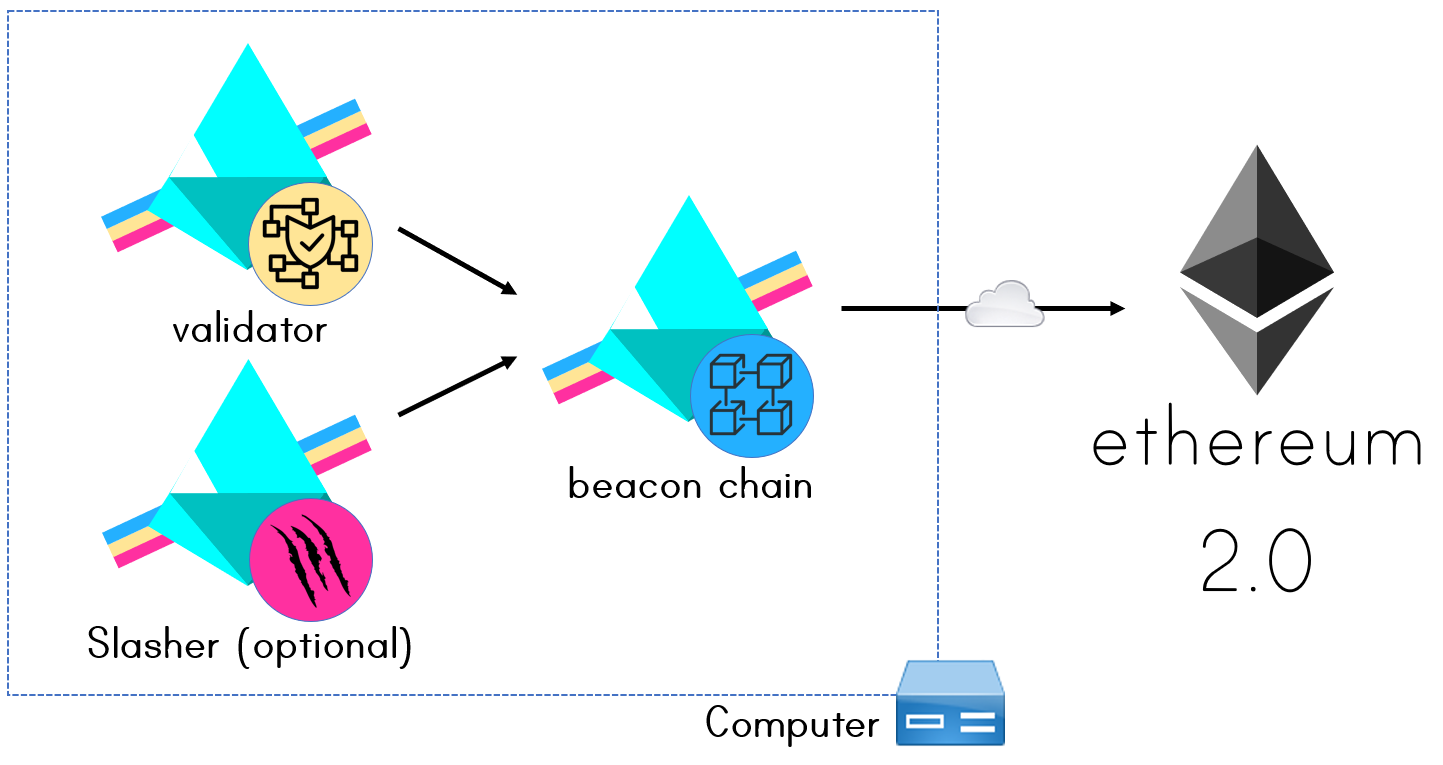
Prysm client components
When a Prysm client is initialized out of the box, it starts a variety of services that run in parallel to handle everything required for the life cycle of the beacon chain. In no particular order, Prysm includes:
- A beacon node which powers the beacon chain at the core of Ethereum consensus.
- A validator client connects to the beacon node and manages staking keypairs.
- A public RPC server to request data about network state, blocks, validators etc.
- A persistent key-value store in the form of a database (BoltDB).
- A P2P networking framework and server to connect with other beacon nodes.
- Monitoring and metrics gathering technologies Grafana and Prometheus track everything that's happening across beacon nodes in the network.
Prysm client functionality
Ethereum proof-of-stake is coordinated by a consensus chain known as the beacon chain. This beacon chain serves as a mechanism to manage a set of Proof-of-Stake validators and to drive consensus over the execution chain.
The execution chain stores blocks containing user-generated transactions such as token transfers and smart contracts. Rather than the originally-proposed execution shards, Ethereum now scales data availability for rollups through blob-carrying transactions (introduced by EIP-4844 in the Deneb/Dencun upgrade and scaled further by PeerDAS in the Fulu/Fusaka upgrade). Ethereum proof-of-stake consensus provides a massive improvement over proof-of-work.
The beacon chain runs through a distributed network of nodes known as beacon nodes. Participants who want to run a beacon node and help secure the network can stake 32 ETH to have their validator client join the pool of validators, who are responsible for proposing and attesting to new blocks on the beacon chain. This deposit does not come out of nowhere; validators transfer Ether from the execution chain to the system using a validator deposit contract.
Each of these components and their roles in the Prysm client are explained within the following sections of this documentation. If you have any questions, please stop by our Discord.